Eora Global Supply Chain Database (MRIO)
The Eora global supply chain database consists of a multi-region input-output table (MRIO) model that provides a time series of high-resolution IO tables with matching environmental and social satellite accounts for 190 countries. The Eora MRIO features:
- a balanced global MRIO table documenting the inter-sectoral transfers amongst 15,909 sectors across 190 countries
- a complete timeseries for 1990-2023
- Full complement of environmental and social impacts associated with production, covering GHG emissions, labour inputs, air pollution, energy use, water requirements, land occupation, N and P emissions, primary inputs to agriculture (including 172 crops) from FAOSTAT Full list
- a high-resolution version (full Eora) preserving national IO table detail, and a simplified verison (Eora26) with 26-sector harmonized classification
- raw data drawn from a wide range of national and international data sources
- reliability statistics for all results
Looking for classic Eora?
The classic Eora website is in read-only mode here: classic.worldmrio.com
Getting Data
Eora provides a free license for academic use at degree-granting academic institutions (see Licensing page for details). For information on getting a license to access the database please see the licensing page
Eora is available in several formats:
- Individual country IO tables The individual country tables are available for download. These contain the domestic IO or SUT tables, for each country, primary input and final demand blocks, imports and exports itemized by partner, and environmental satellite accounts. Note that these tables have mixed structures so for analysis requiring comparisons across countries we recommend using the simplified Eora26 model.
- Eora26 This is a complete global MRIO table, plus environmental satellite account, in a harmonized 26-sector classification.
- Full Eora This is the complete Eora MRIO table. Contains 5 margins (basic prices, trade margin, transport margin, taxes, and subsidies), mixed classification CIOT/IIOT/SUT tables, and full rectangular trade blocks. Only available to academic users with email registration; other users will need to purchase a license.
Additionally, some applications and analyses built uing Eora (including the carbon footprint of nations and the UNCTAD/Eora Global Value Chain database) are available under the Applications menu.
Who uses Eora?
Eora has been used at Deloitte, KPMG, Ernst & Young, Amazon.com, the European Commission, the IMF, the World Bank, and the UN. The database has been downloaded at over 800 universities. The main papers have received >2600 citations, and studies using Eora have appeared in Nature, Nature Climate Change, and PNAS, and been covered in Science, and Eora-based research has featured in the New York Times, Scientific American, TIME, the Washington Post, BBC, Le Monde, FAZ, and National Geographic.
Some reports using Eora include the following:
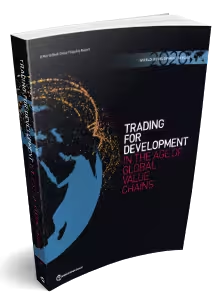
- World Bank World Development Report 2020
- The Carbon Loophole in Climate Policy Report - for the BuyClean initiative. (NY Times, NPR Marketplace)
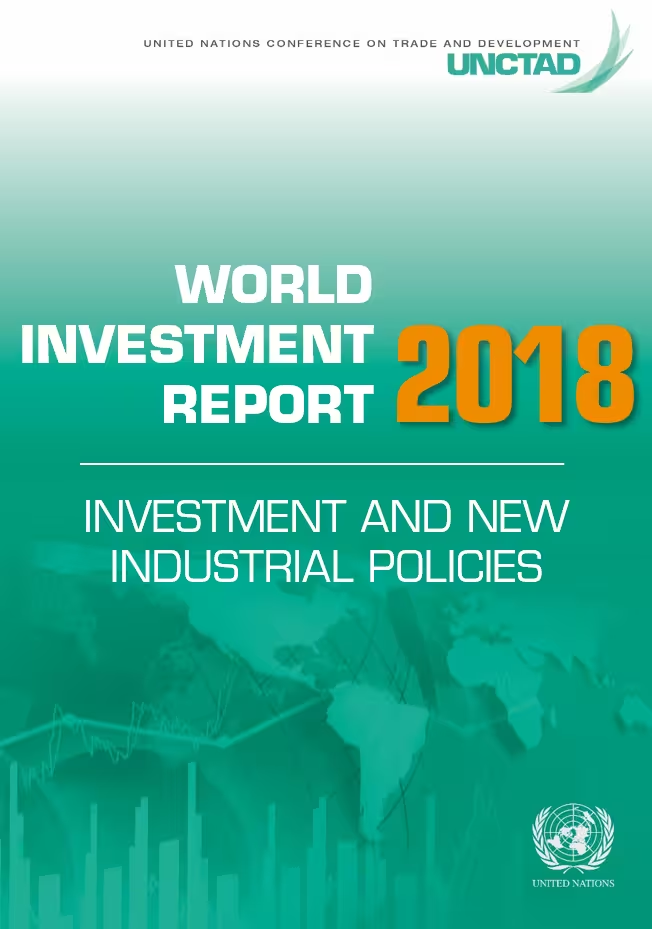
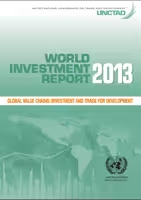
- UNCTAD World Investment Report 2018
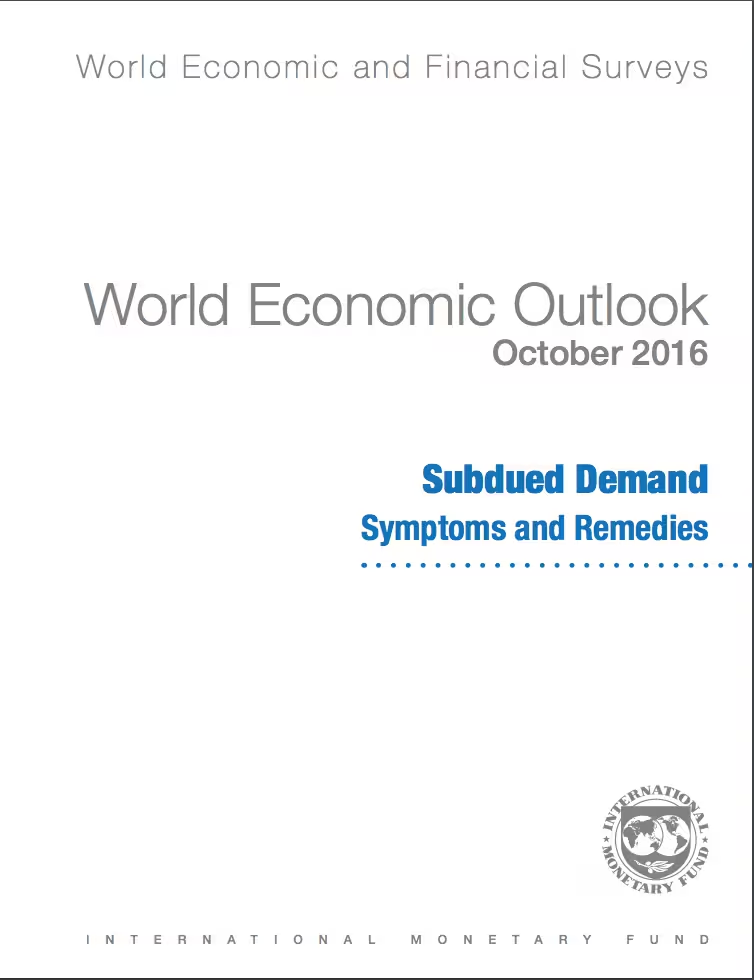
- IMF World Economic Outlook: 2016
- Deloitte: Australia's performance in the G20
- Defra: UK official carbon footprint account
- UNCTAD Global Value Chain database
- EU DG Environment biodiversity footprint report
- Climate Council of Australia, "Renewable Energy Jobs: Future Growth in Australia"
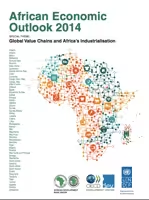
- OECD African Economic Outlook
- IMF Regional Economic Outlook: Sub-Saharan Africa
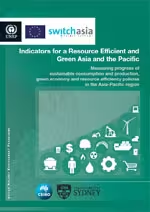
- UNEP: Indicators for a Resource Efficient and Green Asia and the Pacific
- Balancing the G20's Global Impact
- Commonwealth Bank: Assessing the Carbon Emissions of the Group's Lending Portfolio
-
-
-
-
-

-
-
-

-
-

Questions?
The documentation page contains a number of resources for learning about Eora and about MRIO analysis in general. We also maintain a list of Frequently Asked Questions. And of course, with further questions feel free to contact us at info@eora.org.